Should you reface or replace your kitchen cabinets?
What refacing really changes, how to check your cabinet boxes, and when the layout is the reason to start over.
Reface your kitchen cabinets if the boxes are dry, solid and square and the layout already works for how you cook. Replace them if the boxes are water-damaged, made of swollen particleboard, or set up in a layout you'd change anyway. Refacing swaps the doors, the drawer fronts and the visible skin of the face frames and keeps the boxes behind them, so the whole decision rides on those boxes. In Saratoga Springs, where kitchens run from back rooms in nineteenth-century houses to 1990s subdivision kitchens, you'll usually find the answer under the sink.
What refacing changes and what it leaves alone
A refacing job gets you new doors and drawer fronts, new veneer or a painted finish on the face frames and end panels, and new hinges and pulls. You can replace the drawer boxes and slides at the same time, and we'd do it. Worn-out slides are one of the top complaints in an older kitchen, and they're easy to swap while everything's apart.
Refacing doesn't touch the size, position or depth of anything. The sink base stays put. The corner cabinet keeps its awkward blind corner. The wall cabinets stay at the same height. If any of that bugs you every day, new doors won't help.
Painting the doors you have is a lighter option again. On solid wood doors in good shape it can look fine. It won't fix a warped door, a joint that's come apart, or a door style you've grown sick of.
Check the boxes yourself
Take a flashlight and open every cabinet. This is what we look at on a site visit, and you can check most of it before we get there.
Start with the floor of the sink base. Press on it. Soft spots, swelling or dark stains mean a leak, past or present, and particleboard that's been wet doesn't come back.
Find an unfinished edge and look at what the boxes are made of. Plywood shows layers. Particleboard looks like pressed sawdust. Dry, intact particleboard can be refaced, but swollen edges or screw holes that crumble when you touch them mean replace.
Look at the hinges. If they keep pulling loose and the screw holes are stripped, the material around them may be too far gone to hold new hardware. Check the corners of the face frames too, since gaps or loose joints there will telegraph right through new veneer.
Wall cabinets should be screwed through a solid back rail into studs. If one has dropped or pulled off the wall, find out why before you spend money on it.
Last, lay a 4-foot level across the base cabinet tops. Boxes that have settled out of level make it hard to set a new countertop well.
If most of the boxes pass and one or two don't, those can sometimes be rebuilt or replaced to match while the rest get refaced.
When the layout is the actual problem
Plenty of Capital Region kitchens have good cabinets in the wrong places. The fridge sticks out into the main walkway. There's no landing space next to the range. The dishwasher door drops open right where you stand at the sink. There's barely a foot of counter between the sink and the cooktop.
Appliances have changed, too. A lot of today's refrigerators are deeper and taller than the opening built for the old one. A range hood that vents outside may need a different wall cabinet setup than the old recirculating hood did. If the appliances you want don't fit the old boxes, you're replacing the cabinets whether you planned to or not. Our article on planning a kitchen remodel in Saratoga Springs goes through layout and appliance decisions in more detail.
The countertop sits on the boxes
People often plan new counters along with refacing. That can work, but a counter is only as good as what's under it. Stone and quartz need flat, level, solidly fastened support. If the base cabinets have sagged, shims and added blocking can correct a small dip. A bigger one means the boxes can't carry stone.
Order matters here. Countertops get templated after the cabinets are set and leveled, so every cabinet change has to be done first. Change your mind about the cabinets after the counter's been templated and you add time and cost. That's why we settle this in writing up front and handle any later change with a written change order.
Old kitchens in the city
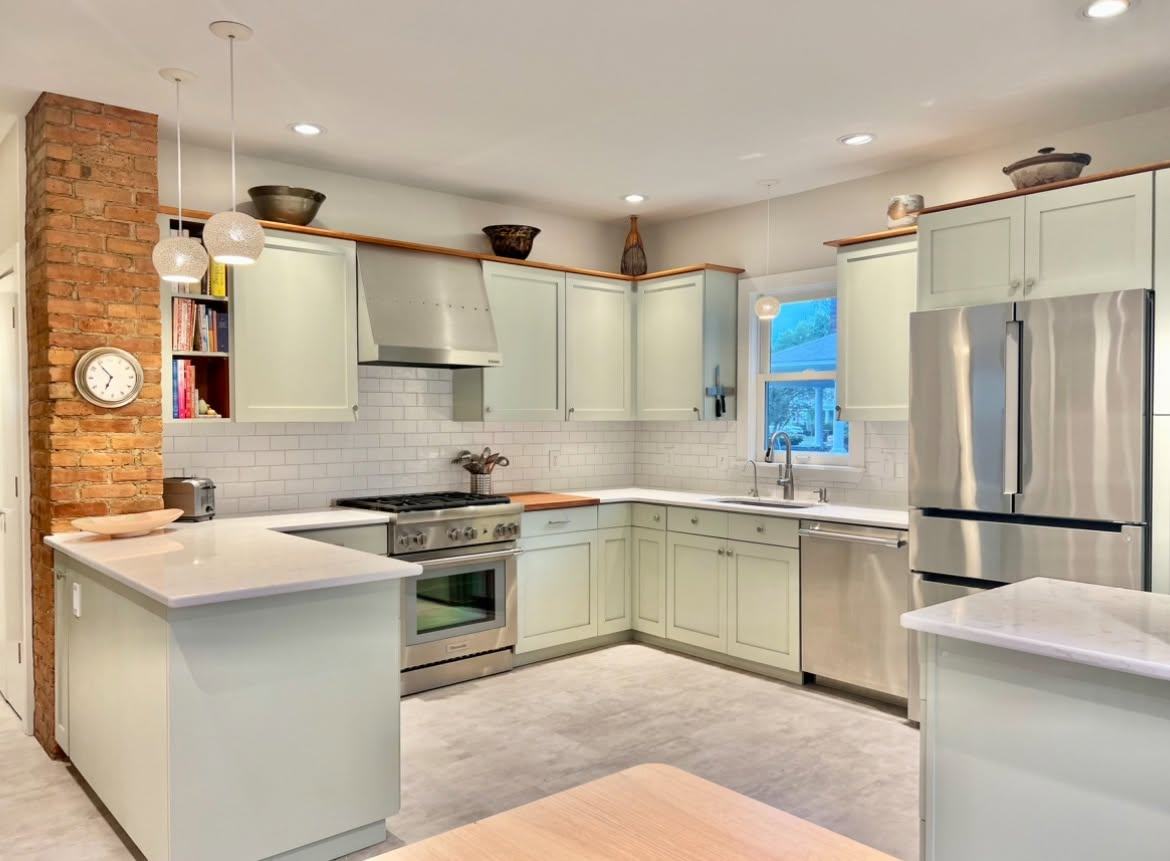
Kitchens in Saratoga Springs' older houses come with their own conditions. The walls and floors are rarely flat or plumb, so new cabinets get scribed and shimmed to look straight. A brick chimney, a window with deep old trim, or a narrow doorway can limit where cabinets go. One kitchen on our site has sage cabinets built around an exposed original brick chimney. That's a room where custom-fitted boxes beat refacing whatever was there before.
In a house built before 1978, test painted surfaces for lead before any demolition. Old cabinets, trim and window casings are common places to find lead paint, and tearing them out stirs up dust. The plaster behind old cabinets often needs repair once they come off, too.
What drives the cost
With refacing, the cost follows the number of doors and drawers, the door style and material, whether drawer boxes and slides get replaced, and any cabinets that have to be rebuilt. With replacement, add the cabinet line and how it's built, demolition, any changes to plumbing, wiring or venting, wall and floor repair, and new countertops, which you'll almost always need when the boxes change.
Here's a test we like. Write down everything you dislike about your kitchen. If it's all cosmetic, price out refacing. If the list says things like "no room," "can't open it" or "always in the way," that's a layout problem, and new doors won't touch it. Our guide to what a remodeling estimate should include can help you compare the two options line by line.
Frequently asked questions
Can particleboard cabinets be refaced?
Yes, if the boxes are dry, intact and still hold a screw tight. Particleboard that's swollen from a leak or crumbles at the hinge holes should be replaced, because new doors won't stay lined up on it.
Can I keep my cabinets and only replace the countertop?
Often, if the base cabinets are level, solid and well fastened. Pulling an old counter can damage the cabinet tops or the backsplash wall, so plan on some repair.
Is refacing faster than replacing?
Yes, generally. You can mostly keep using the kitchen, and there's no plumbing or electrical work. Replacement means demolition, rough work, setting cabinets and then waiting on the countertop template and fabrication, so the kitchen's out of commission longer.
We design and build kitchens from the boxes out, and we'll tell you on site whether yours are good enough to reface. If this is one of several projects on your list, read whether to remodel the kitchen or the bathroom first, or look at our kitchen remodeling page.