How often should you stain a deck in upstate New York?
The real interval for deck stain and sealer in Capital Region weather, the simple water test, and how to get a finish that lasts more than one winter.
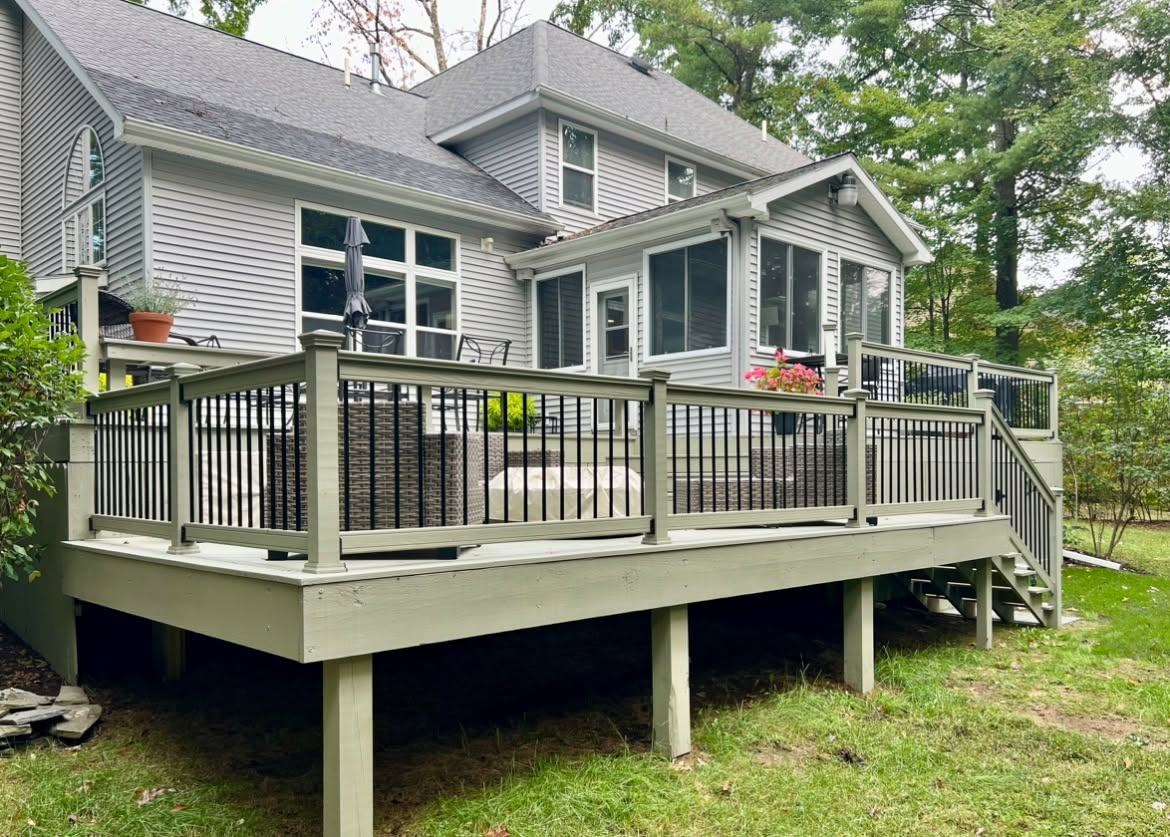
Most wood decks in the Capital Region need a new coat of stain every two to three years. The floor wears out well before the railings do. A clear sealer usually needs redoing every year, and a solid stain can last a long time on rails but tends to peel on the floor. If you want a quick answer for your own deck, splash some water on it. If the water soaks in instead of beading up, it's time.
What winter does to a deck floor
A deck floor has the hardest job of any finished surface on the house. It faces straight up at the sun. Rain sits on it. It spends a good part of the winter under snow, and every thaw soaks the wood, every freeze swells the water inside it, and around here that happens over and over from November to April. Add a snow shovel, ice melt tracked out from the driveway, and wet leaves and pollen sitting in the gaps all spring.
The rails have it easy by comparison. Water runs off them, nobody walks on them, and they dry fast. That's why so many decks look fine from the yard and gray and rough once you're standing on them.
The water test
Pour a cup of water on a few boards. Pick the sunniest spot and the path from the door to the steps, since those go first. Then watch for a minute.
- If it beads up and sits there, the finish is still working. Check again next year.
- If the wood darkens within a minute or two, the finish is wearing thin. Plan to stain this season.
- If it soaks right in, the wood is bare and drinking water every time it rains.
The other signs are easy to spot once you look. The color has faded or gone silver, mostly along the walking path. Small cracks are opening along the grain. Solid stain or paint is coming off in flakes, which nearly always means water is getting under it. Splinters are lifting. Shady corners are turning dark or green.
One caution. If a board is soft when you push a screwdriver into it, or the deck bounces, stain won't help. Read signs your deck needs to be replaced before you spend a weekend on finish.
Which finish to use
The type of finish matters more than the brand.
| Finish | Looks like | How long it lasts on a deck floor | Catch |
|---|---|---|---|
| Clear water repellent | Bare wood | About a year | Doesn't stop the sun; wood still grays |
| Semi-transparent stain | Grain shows, some color | 2 to 3 years | Fades instead of peeling, so it's easy to recoat |
| Solid-color stain | Opaque, like thin paint | Longer on rails, often shorter on floors | Peels on flat boards; redoing it can mean stripping |
On most decks around here we'd put a penetrating semi-transparent stain on the floor. It soaks into the wood instead of sitting on top, so when it wears it fades, and the next coat goes on after a cleaning instead of a strip. Solid stain is fine on rails, posts and skirt boards, where nobody walks and water runs off.
Prep is most of the job
When a stain job fails in a year, it's almost always the prep, not the product. Here's the order:
- Clean it with a deck cleaner made for the purpose, to get off the dirt, mildew and gray fibers. Rinse well. If you use a pressure washer, keep the pressure low and keep the wand moving. Too much pressure fuzzes the grain and gouges soft wood.
- Brighten it if it needs it. An oxalic acid brightener after the cleaner brings the color back and helps the stain soak in evenly.
- Fix things. Drive down popped nails or swap them for screws, replace split boards, and sand the rough spots.
- Let it dry. Dry all the way through, not just on the surface. Give it at least a day or two of dry weather after washing, and go by what the can says.
- Put it on thin. Penetrating stain is supposed to soak in. Wipe off anything still shiny on top after a few minutes, because that shiny film is what peels next spring.
The weather sets the calendar. Most stains want dry wood, no rain for a day or more afterward, and a minimum temperature printed on the can, overnight included. In the Capital Region that means late spring to early fall, and even then morning dew and short October days cut into it. Our post on the best time to build a deck runs into the same limits.
New decks and new boards
New pressure-treated lumber is usually too wet to take stain the day it goes down. Wait until water soaks in instead of beading. That can be a few weeks or a few months, depending on the lumber and the weather. Kiln-dried treated lumber is ready sooner. Either way, follow the stain maker's directions for new wood.
If you're replacing a few boards on an old deck, they'll stick out for a while. After a season and a coat over the whole floor, they blend in.
Or skip the stain altogether
Composite and PVC decking never need stain. They need a wash now and then for dirt and mildew, and they can still fade or scratch. For some people, getting off the restaining treadmill is reason enough to switch when the old floor wears out. Others like real wood and don't mind the upkeep. We lay out the tradeoffs in composite vs wood decking, and deck stain has its spot on our home maintenance schedule for upstate NY.
Frequently asked questions
Can you stain a deck in the fall in upstate New York?
Yes, if the weather gives you a window. You need dry wood, a day or more of no rain after you finish, and temperatures above the minimum on the label, including overnight. By late October those days are hard to find, so do it in September if you can.
Is a metal shovel bad for a stained deck?
Yes. A plastic shovel is easier on the finish and on the wood. A metal edge scrapes through stain and gouges soft boards. Shovel along the boards, not across them, and read the label on any ice melt before you use it on wood.
Do I have to strip the old stain first?
Not if you're putting the same kind of penetrating stain back on and the old coat is just worn. A good cleaning does it. If the deck has peeling solid stain or paint and you want to go to a penetrating stain, the old coat has to come off first.
We build and rebuild wood and composite decks, stairs and railings across the Capital Region. If you're not sure whether yours needs stain, a few new boards or a new frame, we'll tell you which when we look at it. Some of our work is on the decks, stairs and railings page.