Basement stair repair: fixing creaky, loose or unsafe cellar steps
What causes creaky, sagging and rotted cellar stairs, which problems are simple fixes, and when a basement stair should be rebuilt to current standards.
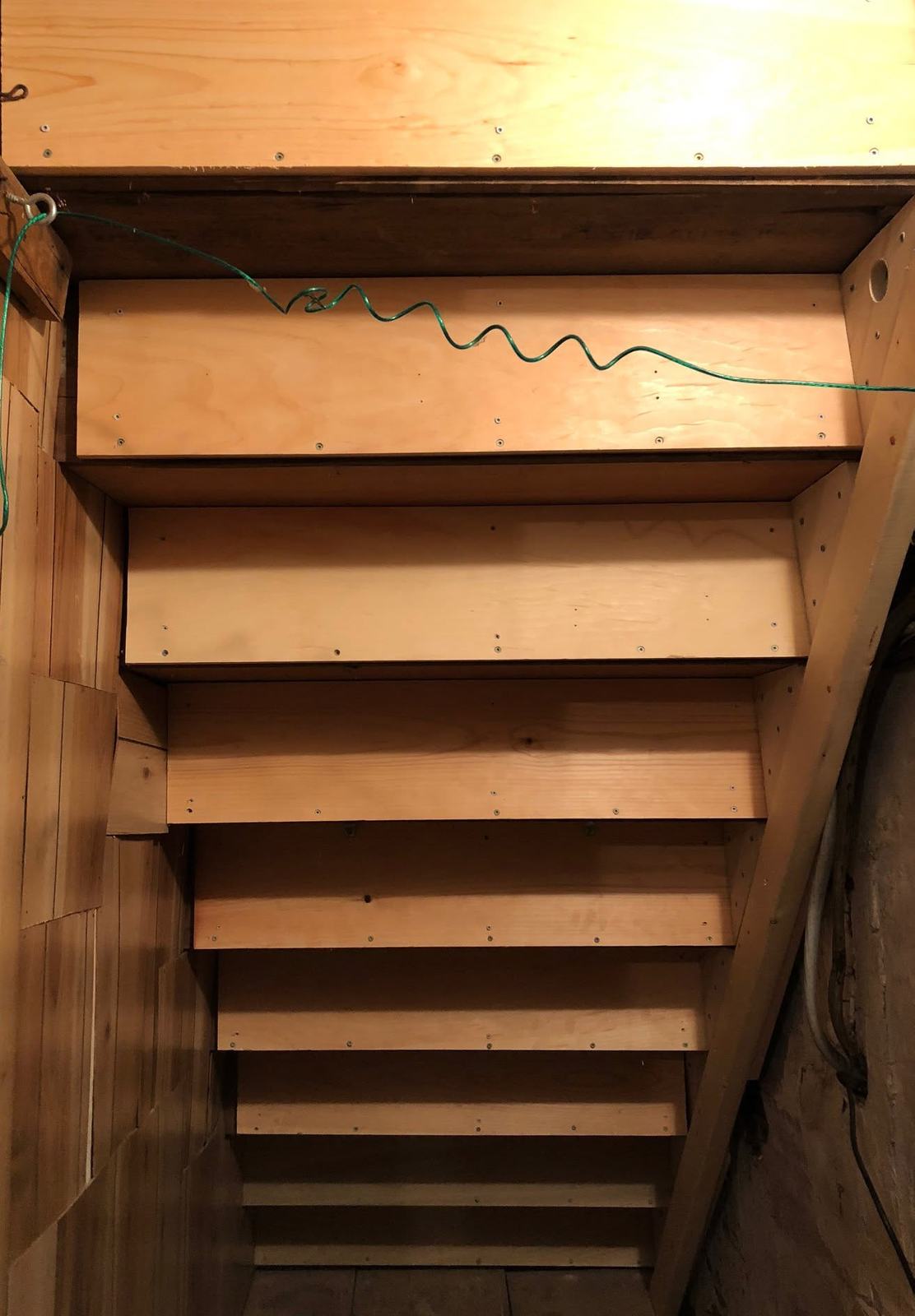
Most cellar stairs that need work have one of three problems: loose or cracked treads, stringers rotting where they sit on a damp floor, or a handrail that's missing or wobbles. Loose treads can be fastened back down and a cracked one swapped out. Once the stringers are soft, the steps are uneven, or the stair was built steep and narrow in the first place, we'd rebuild it. It's safer, and not much more work than chasing repairs. In the old houses of Ballston Spa and the villages around it, the cellar stair was built as a utility stair and has spent a century in damp air.
Why cellar stairs rot
A basement stair has a harder life than the one upstairs. Plenty of older Capital Region basements have stone or rubble foundations and a dirt or thin concrete floor, so the air down there stays damp most of the year. The bottom of each stringer usually sits right on that floor, and the end grain pulls moisture up like a wick. Give it a few decades and the wood goes soft, the stair settles, and the bottom step starts to rock.
Other things speed it up. Treads that were only nailed work loose as the wood shrinks and swells. Stringers cut from lumber that was too small, or notched too deep, sag. Water coming in through a bulkhead or a foundation crack runs straight down the steps. Earlier "fixes" laid plywood or carpet over the treads and left the structure alone.
Look at it from the top
Walk up and down slowly and pay attention to every tread that creaks, rocks or gives under your foot. Look for cracks running across the treads, mostly near the front edge where your weight lands. Notice whether one step feels taller or shorter than the rest. That's the one people trip on. Then take hold of the handrail and pull. It shouldn't move at all.
Then get underneath
Push a screwdriver into the bottom of each stringer where it meets the floor. Sound wood resists. Soft, crumbly wood is the main thing you're looking for.
Look for dark staining, mold, or white fuzzy growth on the wood. All of it points to moisture that doesn't go away. Small patches of surface growth on wood can often be cleaned once the water source is fixed. Heavy mold, or mold on other things in the basement too, is a job for a mold remediation professional, not a scrub brush.
Check how the top of the stair hangs on the floor framing. Old stairs were sometimes just nailed to the edge of a joist, and over time they pull away. Last, see whether the treads sit fully on the stringers or rest on little cleats.
Fix it or rebuild it
| What you found | What we'd do |
|---|---|
| A creak or a little movement in one or two treads | Screw the treads to the stringers with construction adhesive |
| One cracked or split tread | Replace that tread |
| Loose handrail | Re-anchor the brackets into solid framing, or put up a new rail |
| Soft wood in the bottom few inches of the stringers | Sister new stringer sections, or rebuild the lower stair |
| Rot through the stringers, uneven rises, steep pitch | Rebuild the stair |
Sistering means bolting or screwing new lumber alongside the bad section so it carries the load. It works when the rot is limited and the rest of the stringer is solid. If the stringers are soft for much of their length, or the stair was laid out badly to begin with, sistering just buys a few years. Rebuild it.
When we rebuild a cellar stair, we get the bottom of the stringers up off the damp floor, usually on a small concrete pad or over a moisture barrier, and we use treated or rot-resistant lumber anywhere the wood has to touch masonry or the slab.
What the code says
The New York State Residential Code, which is based on the International Residential Code, covers new stairs. Any stair with four or more risers needs a handrail, mounted 34 to 38 inches above the tread nosings. For new work the code also caps how tall a step can be and how shallow a tread can be, and it wants every step close to the same height. Under the IRC, risers can be no more than 7 3/4 inches and treads at least 10 inches deep.
Lots of old cellar stairs are steeper than that, with tall risers and shallow treads. Repairing an existing stair often doesn't trigger full compliance. A complete rebuild generally does, and in a tight basement a stair that meets code may need more run than the old one had, so it may have to land in a different spot or turn partway down. Talk to your town or village building department before you tear the old one out. For more on rail placement, see when stairs need a handrail.
Safer this week, before the repair
You don't have to wait for the rebuild to cut down the risk. Put up a handrail on at least one side if there isn't one. Get better light on the stair, with a switch at the top and another at the bottom, and have an electrician do that wiring. Paint the edge of the top and bottom steps a contrasting color, or use tape, so they're easy to see. Clear the boxes and paint cans off the treads and the landing. And if the steps are painted or worn slick, add slip-resistant treads.
Those small changes count most for anyone with balance or eyesight problems. Our home safety checklist for elderly parents goes through the rest of the house.
Stop the water first
A new stair sitting in water will rot just like the old one. Before or during the work, find out where the damp is coming from. The usual suspects are a leaking bulkhead, downspouts dumping next to the foundation, a yard that slopes toward the house, and plain summer humidity. If the cellar door is the problem, read bulkhead door replacement signs. A dehumidifier running through the humid months protects the stair, the floor framing and whatever you keep down there.
For an old village house with more than the stair going on, our guide to remodeling older homes in Ballston Spa covers the other problems that come with houses that age.
Frequently asked questions
Why do my basement stairs creak?
Most of the time the treads have worked loose on the stringers as the wood dried and shrank, so each step rubs the tread against a nail or the stringer. Screwing and gluing the treads down often quiets them. Check the stringers for rot while you're at it.
Can I repair just the bottom of rotted basement stair stringers?
If the rot stops in the bottom few inches and the rest of the stringer is solid, new lumber can be sistered alongside to carry the load. If it runs further up, or the steps are uneven, rebuild the stair.
Does a basement stair need a handrail?
Under the New York State Residential Code, any stair with four or more risers needs one. Nearly every basement stair has more than that, so put up a sturdy rail 34 to 38 inches above the tread nosings.
Cellar stair rebuilds and bulkhead replacements are part of our bulkheads and outdoor work, and we take them on across the Capital Region, Ballston Spa included. We'll look underneath before we tell you whether yours is a repair or a new stair.