Repairing historic homes in Schuylerville and Stillwater
The old houses along the Hudson in Schuylerville and Stillwater need careful repair. What usually fails, what is worth saving, and how to plan the work.
Repairing a historic home in Schuylerville or Stillwater mostly comes down to two jobs: keep the water out and keep the original parts in. Both villages sit along the Hudson and the old canal, with plenty of houses from the 1800s, and what fails on them is pretty consistent. Porches and sills rot, exterior trim wears out, stairs work loose, and the cellars stay damp behind a bulkhead door that's seen better days. Repair and match what's there, don't swap it for lumberyard stock, and fix the water first so the repairs hold.
The river village houses
Schuylerville and Stillwater are on the eastern edge of Saratoga County in the Hudson valley, the country of the Battles of Saratoga and the Saratoga National Historical Park. Both villages grew up along the river and the Champlain Canal. Their main streets and side streets still have a lot of nineteenth-century houses: plain frame farmhouses, Greek Revival and Italianate village homes, and houses that got added onto every generation or so.
Whatever the style, you open one up and find the same things. The framing is old-growth lumber, often denser and more rot-resistant than anything you can buy new, and it's rough-sawn or full-dimension, so a modern 2x6 won't line up with an old one. The foundation is stone or brick, over a low cellar that's damp more often than not. The millwork, stair parts and porch details can't be bought off a shelf anywhere. And there are layers of paint, with lead almost certainly in the bottom ones.
Find the water first
Nearly every failure we see on an old village house goes back to water. Before you plan any cosmetic work, walk around the outside during a hard rain or a thaw and watch where the water goes.
Gutters that overflow and downspouts that empty against the foundation are the usual suspects. Paint peeling in one patch often means moisture is getting in behind it. Push a screwdriver into the bottoms of porch posts, door thresholds and window sills and see if it sinks in. Go down to the cellar and look for damp walls, efflorescence (the white, crusty mineral deposits on stone and brick), or standing water. Outside, check whether the soil or the walk slopes toward the house.
Stopping the water usually costs less than any one of the repairs it causes, and it keeps the new work from rotting the same way the old work did. Our post on how often to paint exterior trim shows how to read the paint for where water is getting in.
Porches, trim and windows
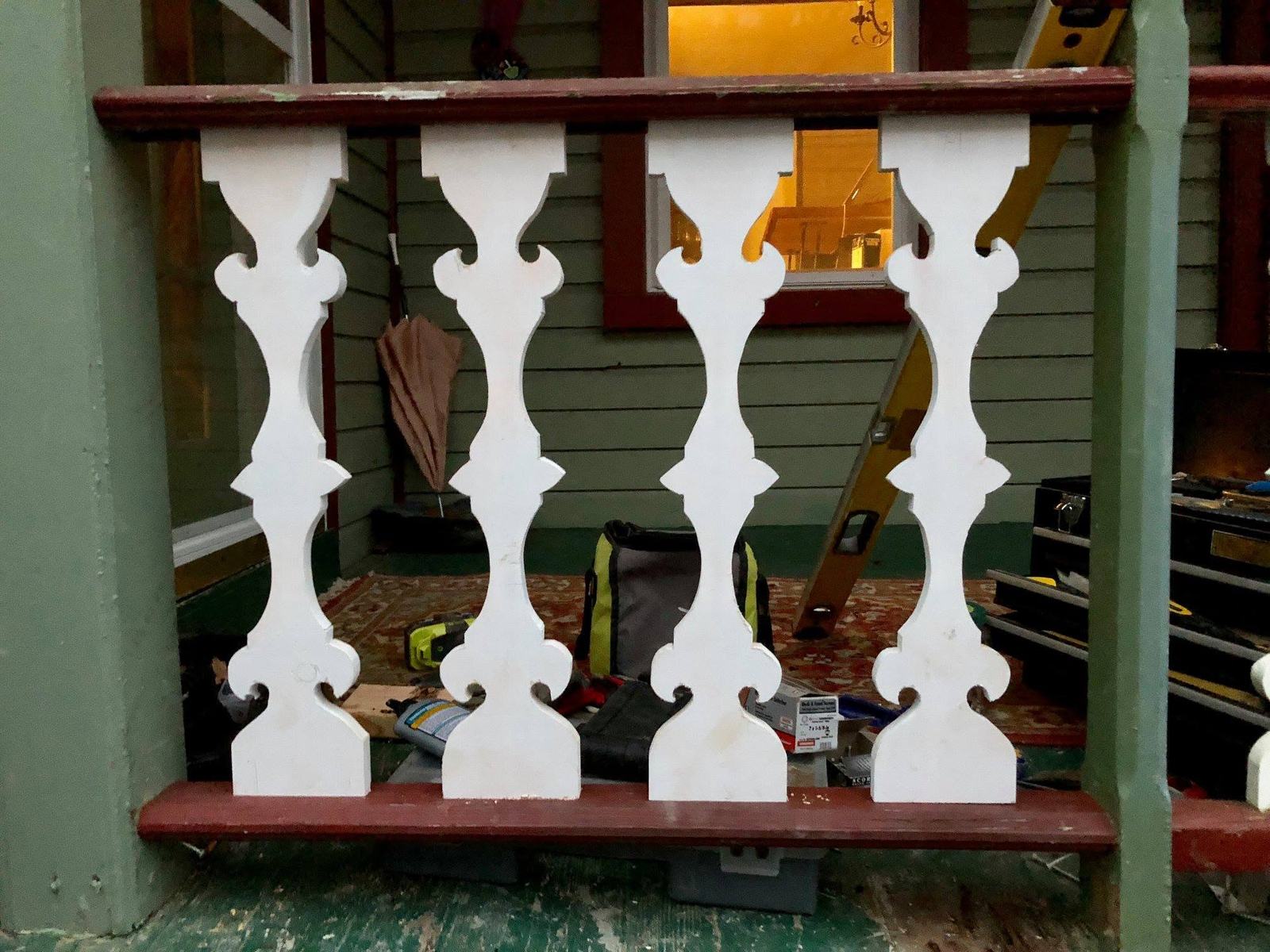
A front porch takes the worst of the weather. The floor boards rot along the outer edge, the posts rot where they meet the floor, and the decorative balusters split and loosen. Almost all of it can be reproduced. A scroll-cut baluster, a turned post or a bracket can be copied from one surviving original, like the scroll-cut balusters on our site. A rotted section of porch floor can be cut out and replaced without rebuilding the whole porch, as long as the framing under it is sound. Check the framing and footings before anything else. New trim on a failing structure won't last.
Trim and sills get the same approach. A soft sill or the rotted bottom of a casing can often be cut out and replaced with a fitted piece of new wood, then primed and painted to match. Tearing out a whole original window or door frame comes last, after every repair has been ruled out.
Stairs and plaster
Inside, the staircase is often the best original feature in the house. Loose balusters, a wobbly newel and squeaky treads are common, and nearly all of it can be fixed. Turned newels and balusters can be reglued, re-pinned and reinforced from underneath, and missing parts can be copied. Our guide to staircase restoration, repair or replace goes through how to decide.
The stair still has to be safe to use. The New York State Residential Code calls for a handrail on stairs with four or more risers, 34 to 38 inches high. On an old stair you can usually add a code rail without spoiling it, for example on the wall side of a stair that only has a balustrade on the open side.
Plaster walls and ceilings crack as an old house moves. A lot of those cracks can be stabilized and patched. When a ceiling is too far gone, it can be covered. We did one with tin-look tiles over the cracked plaster, which looks right in a nineteenth-century room.
Down the bulkhead
Lots of village houses have a cellar you get into through an outside bulkhead door and down a steep set of steps. Steel bulkheads rust through along the bottom and at the hinges. The concrete or stone around them cracks. And the cellar stair underneath is often uneven, narrow, and soft at the bottom where the moisture sits. Replacing a worn bulkhead and rebuilding the cellar stair, both of which you can see on our site, makes the cellar safer and drier to use. Our posts on bulkhead door replacement signs and basement stair repair cover what to look for.
Lead and asbestos
An old house almost certainly has lead paint somewhere, and some have asbestos in pipe insulation, old flooring or ceiling materials. Test before you sand, scrape or tear anything out. Work that disturbs lead paint in a pre-1978 house should be done with lead-safe practices by people trained in them. Anything that tests positive for asbestos should be handled by a licensed contractor that does abatement. That protects your family and anyone working in the house.
Who issues the permit
Structural repairs, porch rebuilds and new plumbing or electrical work usually need a building permit. Schuylerville is a village inside the town of Saratoga, and Stillwater is both a village and a town, so first find out which office handles permits for your address. Ask at the same time whether any local historic review applies to exterior changes. The rules differ from place to place, so confirm them with the village or town before the work goes on the calendar.
Frequently asked questions
Should I replace old wood windows in a historic house?
Not by default. A lot of original wood windows can be repaired, reglazed and weatherstripped, and with storm windows over them they perform reasonably well. Replacement makes sense when the frames are badly rotted. Get a repair assessment before you decide.
Can a rotted porch be repaired without losing its original look?
Usually, yes. Posts, balusters, brackets and floor boards can be reproduced from the originals that survived, and only the damaged pieces have to be replaced. Check the framing and footings first, because new trim on a failing structure won't last.
What is the most important repair on an old house?
Keeping water out. Gutters, downspouts, grading, roof flashing and paint are a lot less exciting than a new kitchen, but water causes most of the rot, settling and interior damage we find in old houses.
We work in Schuylerville and Stillwater as part of the Capital Region we cover. Old stairs, porches, trim, ceilings, bulkheads and cellar stairs all fall under our restoration and built-ins work, and we'd always rather patch an original than pull it.